

If you have ever wondered why 90% of traders lose money, you are not alone. The short answer is that trading stacks difficulty in layers. You face fast markets, steep costs, and your own wiring. The good news is that small, boring rules can move you toward the 10%.
I have spent 15 years covering markets and investor behavior, and I have seen the same pattern across cycles. Most beginners jump in without a plan. They trade too often. They use leverage without guardrails. Then a normal pullback turns into a bigger loss than planned. That is not a moral failing. It is how the game works when you skip the math and the process.
This guide shows you how to avoid the traps and adopt a data-driven playbook. We will define key concepts in plain English. Compound interest means your gains earn gains over time. Diversification means you spread your bets across assets so one mistake does not sink you. We will also connect the dots to today’s backdrop. Rates remain higher than the last decade, volatility clusters around events, and spreads can widen when liquidity thins. That matters for your outcomes in 2025.
This is not financial advice. Talk with a fiduciary advisor before you act.
Understanding Why 90% of Active Traders Lose Money
Most traders lose money not because the market is unfair, but because they enter the market unprepared.
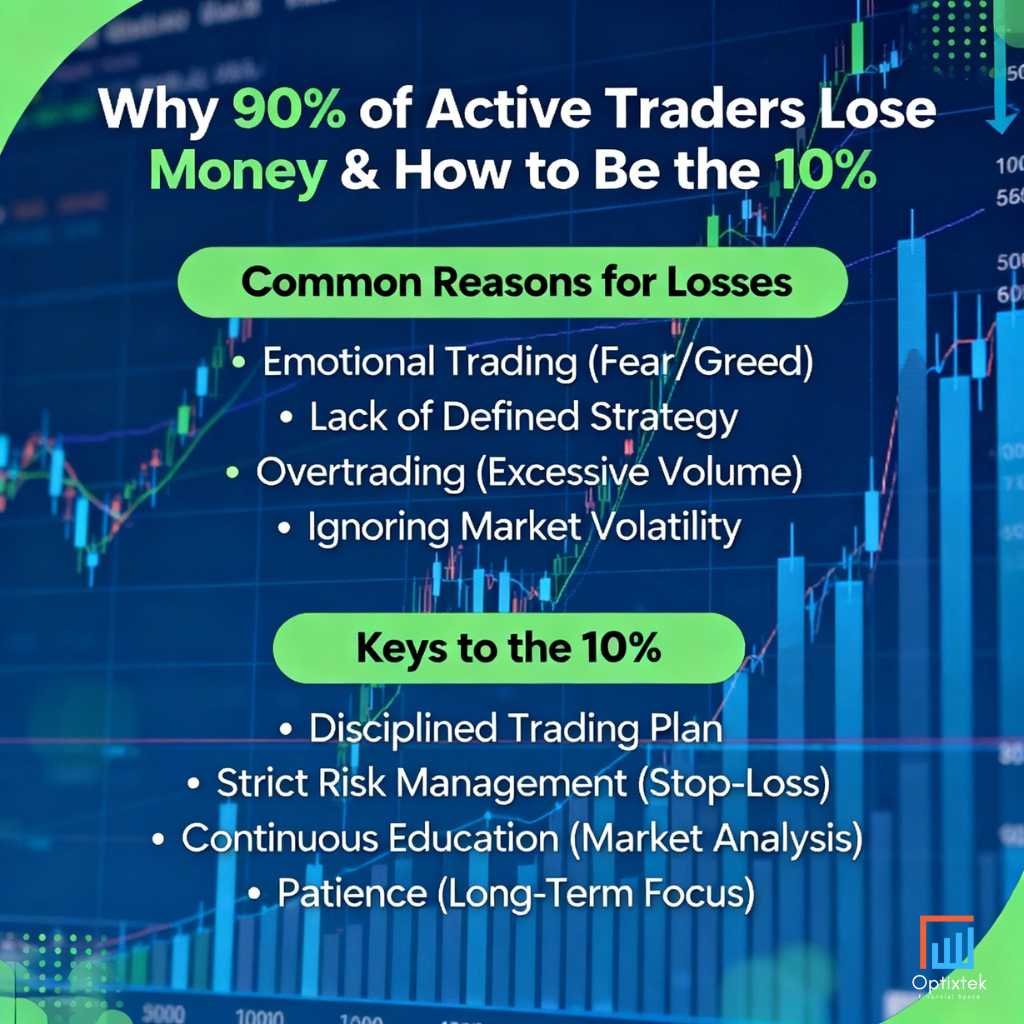
Emotional Decision-Making and Impulse Trading
When emotions drive trading decisions, losses follow. Fear and excitement cause traders to:
- Enter positions too late.
- Exit too early.
- Chase fast-moving markets.
Successful traders rely on logic, not emotion.
Lack of Risk Management Strategies
Risk management determines survival. Many traders risk:
- 10–20% of their account per trade.
- Large positions with no stop-loss.
- High leverage without understanding the downside.
The 10% who win treat capital preservation as rule #1.
Overtrading and Poor Position Sizing
Overtrading drains accounts through spread, slippage, and low-probability setups. Good traders wait for high-quality entries and size positions carefully.
How to Become the 10% Who Actually Make Money
If you want to win, adopt proven habits.
Write a simple plan
Put your rules on one page. Define your market, entry, stop, position size, and exit. Specify when you do nothing. If you cannot explain your edge in two sentences, it is not ready.
Keep risk per trade tiny
Risk is how much you can lose if you are wrong, not how much you buy. Use a fixed percentage per trade so one loss does not wreck the month. Many start with 0.5% to 1%.
Example: Account . Risk per trade or $100. If your stop is 2% away from entry, your position size is $100÷0.02=$5,000.
Aim for positive expectancy
Your system needs positive expectancy. Use this simple formula:
E=(p×average win)−(q×average loss)
where p is the win rate and q=1−p. If E is positive and you size positions well, you can grind upward even with many small losses.
Use edges you can test
Pick edges you can measure. Breakouts after quiet ranges. Mean reversion after oversold reads. Earnings drift with defined stops. Backtest on clean data, then paper trade live to check slippage. Be skeptical of perfect equity curves.
Execute with checklists
Airline pilots use checklists because memory fails under stress. Traders should, too. Before each trade, confirm trend, volatility, entry, stop, size, and catalyst risk. One missed item can double your loss.
Journal and review weekly
Write down every trade. Record the setup, reason, emotions, and outcome. Tag common mistakes. Review each week. Cut what does not work. Scale what does.
Respect taxes and costs
Active strategies can trigger short-term taxes, which are higher than long-term rates for many filers. Include tax drag and borrowing fees in your math. If your edge is thin, consider a core-satellite mix with a low-cost index core.
Common pitfalls to avoid
Chasing and FOMO
If you feel rushed, wait one bar or one day. Good setups return. Late entries compress reward-to-risk and raise regret.
Moving stops wider
A stop is there to cap damage. If the price hits the stop, the market disagrees. Take the loss and reset. Do not convert a trade into a long-term bag.
Signal overload
Too many indicators can paralyze you. Start with price, volume, and one filter like a moving average or RSI. Add only if it improves results.
Ignoring base rates
Before you trade a pattern, ask how often it works in your market. If a setup only wins 40% of the time, you need larger winners than losers to net out. Base rates do not care about your conviction.
Your 30-day starter plan
Week 1: Write your plan. Pick one setup. Define entry, exit, and size. Open a journal.
Week 2: Paper trade 10 signals. Track slippage and spreads. Refine your rules.
Week 3: Go live with a tiny size. Risk 0.5% per trade. Avoid trading during major data releases.
Week 4: Review every trade. Drop the worst mistakes. Keep what worked. If your expectancy is positive, scale size by 10% next month.
Technical Mistakes That Destroy Trading Accounts
Even highly motivated traders fail because of poor techniques.
Trading Without a Strategy or System
A system-less trader reacts to noise. A system-based trader reacts to signals.
Misunderstanding Technical Indicators
Indicators are tools, not magic wands. Traders who rely on indicators without understanding them misread markets constantly.
Not Tracking Performance Through Journaling
A trading journal reveals:
- Your best setups.
- Your worst habits.
- Your emotional triggers.
Skipping journaling slows improvement dramatically.
Market Realities Most Traders Ignore
Professional traders know how the market works. Most beginners don’t.
The Role of Professional Market Makers
Market makers and institutions often move the market. Their algorithms are faster, more accurate, and designed to take advantage of retail traders.
Spread, Slippage, and Hidden Costs
Even “zero-commission” platforms earn from spreads. Those tiny fees add up, especially for high-frequency traders.
The Myth of Quick Riches
Movies and social media glamorize overnight wins. But real trading profits come from:
- Months of practice.
- Years of consistency.
- Data-driven decisions.
Not luck or hype.
Step-by-Step Guide to Becoming a Profitable Trader
1. Define Your Trading Edge
Your edge might be a pattern, indicator, or market behavior you understand better than most.
2. Test and Refine Your Strategy
Backtest it. Forward test it. Adjust your rules before scaling up.
3. Scale Up Only When You’re Consistent
Trade small until your system proves itself.
When trading is not the right tool
Some readers need cash flow stability more than trading risk. That is fine. You can build wealth with diversified index funds, steady contributions, and smart budgeting tips in 2025. Diversification across stocks, bonds, and cash reduces big draw downs. Dollar-cost averaging aligns with paychecks and cuts timing stress.
If you cannot build a three-month cushion yet, start with one month. Use a high-yield savings account and automate transfers the day you get paid. As inflation ebbs and flows, adjust your budget for essentials first. Your future self will thank you.
FAQs About Why 90% of Active Traders Lose Money
1. Is it true that 90% of traders lose money?
Yes, due to poor risk management, lack of education, and emotional trading.
2. How much money do I need to start trading?
You can start small, but proper risk management is essential at any account size.
3. Can trading be a full-time career?
Yes, but only after years of practice and consistent profitability.
4. Are trading courses worth it?
Some are helpful, but hands-on practice and data analysis matter more.
5. How long does it take to become a profitable trader?
Most traders need 1–3 years of consistent effort.
6. Should I automate my trading?
Automation helps, but only if you fully understand your strategy first.
Conclusion
Most traders lose because markets punish overconfidence, and costs eat thin edges. The path to the 10% is not a secret. It is a checklist. Keep risk per trade tiny. Use tested rules with positive expectancy. Respect taxes, spreads, and macro calendars. Journal, review, and improve one small piece each week.
You do not need to win every day. You need to avoid the big mistake that knocks you out. If you build a core long-term portfolio and add a humble trading plan on top, you can give yourself a fair chance. Start small. Track everything. Let the data talk, not your ego.