

The Philosophy Behind Value Investing
Warren Buffett, renowned as the Oracle of Omaha, has perfected a distinct approach to investing, rooted in the principles of value investing. This investment strategy is predicated on the notion of acquiring stocks that are undervalued relative to their intrinsic worth. At the heart of Buffett’s philosophy is the belief that a sound investment must not only be cheap in price but also possess robust potential for long-term growth. Consequently, investors are encouraged to look beyond fleeting market trends and focus on a company’s underlying fundamentals.
Fundamental analysis is a cornerstone of Buffett’s investment philosophy. He emphasizes the importance of extensive research prior to making investment decisions. For Buffett, understanding a company’s business model, competitive strategy, and market position is critical. This methodical approach entails evaluating financial statements, profit margins, and growth patterns, among other financial metrics. By grasping a company’s true value and its place within the market, investors can identify prospects that are likely to yield favorable returns over time.
A fundamental aspect of Buffett’s commitment to value investing is the distinction he makes between price and value. While price reflects what the market is willing to pay for a stock at a given moment, value speaks to what the stock is fundamentally worth. Buffett’s strategy involves investing in businesses that exhibit a competitive advantage, such as strong brand recognition or unique intellectual property, which can sustain profitability even in challenging economic environments. This focus on quality, coupled with price, serves as a guideline for investments, allowing for more informed and strategic decision-making.
By adhering to these principles, Buffett has demonstrated that a disciplined approach to understanding a company’s intrinsic value can lead to successful investment outcomes, consistently reinforcing the merits of his value investing strategy.
Key Tenets of Buffett’s Investment Approach
Warren Buffett’s investment strategy is characterized by several key tenets that have guided his success over the decades. One of the foundational principles is the long-term perspective he adopts. Unlike many investors who may react impulsively to short-term market fluctuations, Buffett emphasizes the importance of investing with a horizon that spans several years, if not decades. This approach allows investors to benefit from compounding returns and to ride out market volatility, ultimately leading to greater wealth accumulation over time.
Patience is another critical facet of Buffett’s philosophy. The Oracle of Omaha has consistently advised investors to remain steadfast in their convictions, even in the face of market downturns. This resilience can often lead to significant opportunities for value investing when stock prices are low. Moreover, this patience is closely linked to Buffett’s ‘buy and hold’ strategy, where he encourages acquiring shares of fundamentally sound companies with the intention of holding them for the long haul. Such companies typically exhibit consistent earnings and strong competitive advantages, which Buffett refers to as “economic moats.”
Buffett also advocates for investing in businesses that possess predictable earnings, allowing for better forecasting of future performance. This preference steers him towards companies with established operational histories and solid management teams. While some investors might favor diversification to mitigate risks, Buffett often leans towards concentrated investments in businesses he thoroughly understands, arguing that this can lead to superior returns as opposed to spreading investments too thinly across numerous stocks.
Real-life examples of Buffett’s principles can be observed in his investments in companies like Coca-Cola and American Express, both of which have demonstrated strong earnings growth and resilience. By following these fundamental tenets, investors can gain insights into the investment strategies that have propelled Warren Buffett to become one of the most successful investors of all time.
Buffett’s Strategies for Stock Selection
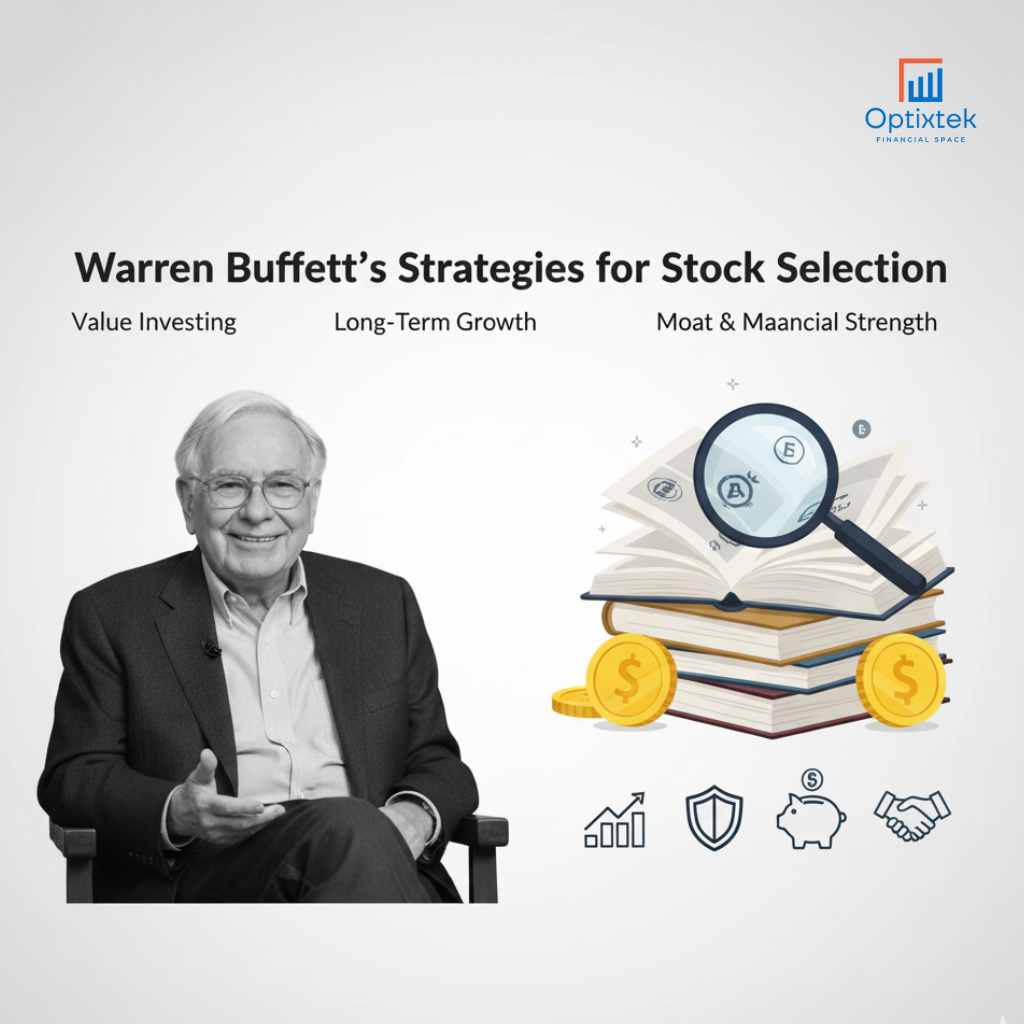
Warren Buffett’s investment philosophy is rooted in a series of well-defined strategies that guide his stock selection process. A critical aspect of his approach is the emphasis on fundamental financial metrics that indicate a company’s health and long-term potential. Among these metrics, return on equity (ROE) stands out as a significant determinant. Buffett prefers companies that exhibit a strong ROE, as it reflects how effectively management is utilizing shareholders’ equity to generate profits. A higher ROE often suggests a firm is capable of reinvesting its earnings effectively, which is crucial for future growth.
Profit margins are another essential factor in Buffett’s evaluation. He gravitates towards companies with consistent and high-profit margins, as they are typically indicative of a sustainable competitive advantage. By focusing on firms that can maintain elevated profit margins, Buffett aims to invest in businesses that can weather economic downturns while preserving their profitability. Additionally, the level of debt carried by a company is scrutinized carefully; Buffett seeks organizations with manageable debt levels, underscoring the importance of financial stability and allowing for greater flexibility in operations and strategic decisions.
Beyond quantitative analysis, Buffett places a strong emphasis on qualitative factors, notably the quality of a company’s management and its corporate governance practices. He believes that competent and trustworthy managers are more likely to steer a company toward enduring success. Furthermore, Buffett tends to favor industries and sectors in which he possesses substantial knowledge. This affinity enables him to make informed judgments about a company’s competitive landscape, future prospects, and inherent risks. Ultimately, by applying these principles, aspiring investors can better recognize potential opportunities in line with the Warren Buffett investment strategy, enhancing their own decision-making in the stock market.
Lessons from Buffett for Modern Investors
Warren Buffett’s investment strategy is celebrated not just for its success but for the fundamental principles that underpin it. Modern investors can glean invaluable insights from his approach, which emphasizes emotional discipline, continuous learning, and a long-term perspective. One of the most significant lessons is the importance of emotional discipline in investing. Buffett advises against making decisions based on market fluctuations or emotional responses. Instead, he advocates for a steadfast commitment to research and analysis, ensuring that investment choices align with a well-thought-out strategy rather than impulsive reactions to market trends.
Moreover, learning from mistakes is a vital element in Buffett’s investment philosophy. He encourages investors to reflect on their past decisions, both good and bad, as a means of personal growth. Such reflection not only helps in avoiding similar pitfalls in the future but also fosters a deeper understanding of the market dynamics. This emphasis on self-improvement fuels a continuous pursuit of knowledge, another cornerstone of Buffett’s strategy. He believes that an informed investor is a successful investor, constantly seeking to expand their understanding of businesses, economic indicators, and industry trends. Modern investors should adopt a similar mindset, regularly consuming literature, attending seminars, and engaging in discussions with other knowledgeable individuals in the field.
Finally, the benefits of a long-term investment horizon cannot be overstated. Buffett’s success largely stems from his ability to remain patient and resist the urge to seek quick returns. By focusing on the intrinsic value of investments and holding them over time, investors can ride out market volatility and capitalize on compounding growth. This long-term approach not only aligns with Buffett’s principles but also encourages a steadiness that modern investors can greatly benefit from. In conclusion, by integrating these lessons on emotional discipline, learning from mistakes, ongoing education, and a long-term perspective, investors can refine their strategies and make informed financial decisions that mirror the success of Warren Buffett.